

Education continues to evolve in response to new technologies, changing student needs, and growing community expectations. Through this evolution, there is greater recognition that the spaces where students learn play a critical role in their success. Designing effective educational facilities requires more than architectural expertise. It demands a strong understanding of how physical environments influence teaching, learning, and well-being. This is where the Accredited Learning Environments Planner (ALEP) designation comes in.

What is ALEP Certification?
Awarded by the Association for Learning Environments (A4LE), the ALEP credential represents the most advanced level of professional certification for educational facility planners. It recognizes professionals with deep knowledge of how to align space with educational goals and long-term community needs.
Among the two pathways available for achieving ALEP certification, RTA’s ALEP certified architects earned their designation by completing A4LE’s Advanced Academy Certificate Program pathway — a year-long, intensive training that builds expertise across all aspects of planning, designing, and evaluating learning environments. This program is designed to expand the role of architects by strengthening their ability to lead informed, strategic, and collaborative planning processes.
Having an ALEP certified professional on a project brings value beyond design. These individuals are trained to lead community engagement, guide visioning processes, develop educational space models, and help districts translate goals into actionable design solutions.
Expanded Expertise Through Certification
The ALEP process builds skills in seven key areas that go beyond traditional architectural services:
-
Educational Visioning
Facilitating the creation of guiding principles and long-range educational goals to support learning outcomes. -
Community Engagement
Leading inclusive conversations and workshops that gather input from students, educators, families, and stakeholders. -
Learning Environment Pre-Design Planning
Managing early planning efforts such as facility assessments, demographics, budgeting, and educational planning. -
Educational Facility Implementation, Project Management and Project Delivery
Supporting design teams in aligning the final building with the community’s vision and educational priorities. -
Project Implementation and Delivery
Applying knowledge of codes, scheduling, budgeting, and delivery methods to bring educational spaces to life. -
Assessment of School Facilities
Reviewing the condition and effectiveness of school spaces before and after construction to guide continuous improvement. -
Ethics and Professionalism
Leading transparent, community-based planning efforts that reflect shared values and long-term priorities.
These competencies allow ALEPs to support school districts from early visioning through post-occupancy, helping support the creation of learning environments that are thoughtful, inclusive, and purpose-driven.
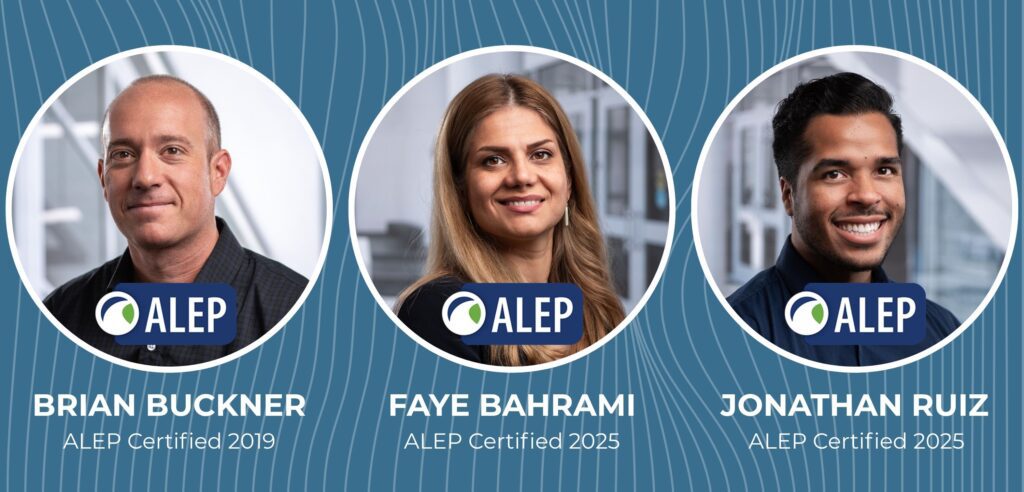
Three ALEPs in Kentucky – and They’re All at RossTarrant Architects
We are proud to share that Jonathan Ruiz and Faye Bahrami have recently earned their ALEP certification, joining Brian Buckner, who has held the designation since 2019. With this milestone, RossTarrant Architects is now home to the only three ALEP certified architects in the state of Kentucky.
This milestone reflects not only individual excellence, but also our firm’s ongoing commitment to leadership in educational design. Brian, Jonathan, and Faye each bring a high level of expertise, insight, and passion to their work. Their ability to guide school districts through thoughtful, research-informed planning processes helps create environments that truly support student success. We are proud to have them as part of our team, helping shape the future of learning environments across Kentucky and beyond.